
14.06.2018
CUT-UP holds a discussion on the circular economy in the textile industry
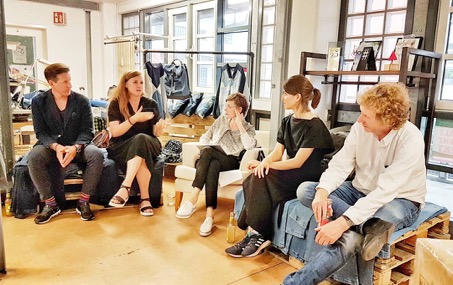
On 12 June 2018, presenter Irina Rohpeter discussed the variety of ways in which sustainable solutions can be implemented in the textile and clothing industry with her guests Prof. Dr Michael Braungart, (co-founder of the Cradle-to-Cradle concept), Friederike von Wedel-Parlow (Director of the Beneficial Design Institute), Timo Perschke (Managing Director of Pyua) and Natascha von Hirschhausen (designer of the Natascha von Hirschhausen label).
Using high-quality single-material fabrics, the cultivation and processing of which can be traced at every stage, and ensuring that no offcuts are produced when designing garments: this is the concept followed by fashion designer Natascha von Hirschhausen. She calls this approach the ‘transformation economy’, which focuses on ensuring that garments are well thought-out from the outset and manufactured to a high standard – thereby protecting the environment. Upcycling or recycling are not long-term solutions in a sustainable sense, according to von Hirschhausen, as they are based on existing consumption patterns and the often wasteful use of resources, without seeking to actively change them.
Michael Braungart’s ‘Cradle-to-Cradle’ concept takes up this idea in a similar way. The correct approach, he argues, is not to make existing products more efficient, but to design things to be useful. The notion of sustainability, which is often promoted from today’s perspective, is not a forward-looking concept, says Braungart; rather, it is important to promote innovation and develop a comprehensive understanding of quality. Waste generated during production and from offcuts must therefore simply be regarded as a quality defect. Raw materials must be used in such a way that, at the end of a product’s useful life, they can be reused in new products.
A term often discussed in this context as a criterion for sustainability is the durability of garments. But is it sustainable and in keeping with the times for consumers to actually wear their clothes right up until the end of their useful life? Friederike von Wedel-Parlow considers this approach to be outdated: durability is not a realistic concept. Rather, the focus should be on thinking in terms of different usage cycles for garments. For example, a T-shirt could be manufactured in a much more resource-efficient and environmentally friendly way if algae were used instead of cotton. According to von Wedel-Parlow, this ultimately makes the product more sustainable – despite its comparatively shorter lifespan.
CUT-UP is a collaborative project between Bridge&Tunnel, designxport, Frauke von Jaruntowski and the Hamburger Stiftung für Wirtschaftsethik. Over a two-year period running until the end of 2018, the series of discussions will address topics ranging from sustainability and fair trade to supply chain transparency, amongst others.
The Hamburger Stiftung für Wirtschaftsethik addresses ethical risks in the textile industry through initiatives such as its ‘Water Stewardship in the Clothing Industry’ project.