Sector-specific Ethical Risk Assessments | Framework
The era framework presents the results of the Ethical Risk Assessments for the electrical recycling, fish, coffee, cocoa, toys, textiles and tourism sectors.
The diagram illustrates the respective value chains and assigns the key problem areas to the individual process steps. Hover your mouse pointer over the framework to see at which point in the value chain particular issues in the areas of the environment, human rights, labour practices, governance and product responsibility carry the most weight. The pop-up texts provide further information on the specific background to business ethics challenges.

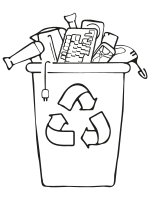



Value Chain Electrical recycling
-
- Environmental
indicators -
Emissions, effluent and waste
The greatest risk from emissions, effluent and waste arises from electrical recycling in countries without suitable recycling infrastructure. There, improperly processed electrical components release toxic substances, and chemicals from separation or recovery processes seep into the groundwater. For example, the level of pollutants in the soil at Agbogbloshie, a rubbish tip in the heart of Ghana’s capital, Accra, exceeds the limit permitted in Europe by a factor of 50.
- Resource consumption
-
Biodiversity
Biodiversity encompasses the conservation of biological diversity – from animal and plant species to microorganisms and complex habitats. In the field of electrical recycling, a risk arises particularly when workers in the informal sector sort old electrical appliances by hand and extract raw materials without access to suitable recycling infrastructure. The resulting environmental damage threatens biodiversity in many ways – an indispensable foundation for human life.
- Transport emissions
- Animal welfare
- Human rights
- Discrimination
-
The interests of the local community
The interests of the local population are particularly at risk when waste electrical and electronic equipment bypasses the formal value chain and ends up in informal recycling systems in the recipient countries. This area of risk highlights local issues such as groundwater supplies and the education and health systems.
-
Child labour
Child labour affects many sectors and always poses a significant reputational risk. In the electronics recycling sector, companies’ responsibility is admittedly less direct than in the textile, cocoa or toy sectors, where greater attention is paid to working conditions at suppliers. However, more and more European consumers are recognising the link between their electronic waste and the children working on mountains of rubbish.
-
Forced and compulsory labour
Reports of forced and compulsory labour in this sector have not yet been confirmed. One thing is clear, however: working conditions in sorting, recycling and extraction processes are often characterised by dependency and arbitrariness. Children and young people are particularly affected – the extent of this depends on the structure of the informal sector.
- Freedom of association
- Work practices/
-quality -
Employment
status -
Health and Safety at Work
In countries such as Pakistan, Ghana, Vietnam and Nigeria, people of all ages work in hazardous conditions. They search for recyclable raw materials and, in doing so, expose themselves to significant health risks without adequate health and safety protection. The initial stage of sorting and separation carries a particularly high risk of serious consequences: Many develop cancer, and organs such as the liver and kidneys often sustain irreparable damage. In addition to the long-term damage caused by inhaling toxic substances and coming into contact with corrosive materials, accidents occur daily that result in acute injuries.
- Discrimination / Diversity
- Governance
-
Corruption, bribery, accepting benefits
According to Ethical Risk Assessment, corruption, bribery and the acceptance of undue advantages are among the greatest risks. The reason lies in the sector’s structural vulnerability, which arises from misguided incentives. The focus is therefore less on individual instances of bribery or the acceptance of benefits, and more on analysing the corrupt environment and its mechanisms. Legal grey areas in electrical recycling are often exploited to the full, driven by economic incentives at the expense of legality.
-
Anti-competitive behaviour
Violations of competition law occur particularly in the areas of collection and transport. The sheer volume of regulations and the complex legal landscape have given rise to a large service sector which, in most cases, takes on many processes on a long-term basis. A lack of transparency and convoluted business relationships provide ideal breeding ground for unfair practices. The division of labour between remarketing companies and waste disposal service providers on the one hand, and recycling firms and manufacturers on the other, shifts responsibilities and thus encourages non-compliant behaviour.
-
Compliance
In the field of electrical recycling, compliance regulations govern how waste electrical and electronic equipment must be disposed of in an environmentally sound manner. Breaches occur particularly in the first three stages of the value chain: registration, collection, and transport or import. It is precisely here that it becomes apparent that, despite their detailed provisions, the existing laws are often not effective enough.
- Tax evasion
- Poor governance
- Product
responsibility - Customer safety
- Labelling of products
- Marketing, Advertising
- Protection of customer data
- Environmental
Electrical and electronic equipment recycling – an Ethical Risk Assessment
Despite a complex European regulatory framework, including comprehensive and, in this respect, unique producer responsibility, people and the natural environment in non-European countries suffer as a result of the disposal of end-of-life electrical appliances from Western industrialised nations.
Although all serious ethical issues in electrical recycling, particularly environmental violations and hazardous working conditions, are predominantly found in the informal sector of West African and South-East Asian countries, the core problem lies within European borders – specifically in the transition between the formal and informal sectors. Clearly, on the path between the end consumer, who discards a product, and the actual recycling process, significant value is created with strong economic incentives, involving a multitude of stakeholders. Together, these form a constellation which, due to legal grey areas, a lack of transparency and strong dynamics, provides a breeding ground for corruption.
The following risks are particularly serious in the Electrical Recycling industry:
- Occupational health and safety
- Biodiversity
- Compliance
- Emissions, effluent and waste
- Interests of the local population
- Child labour
- Corruption, bribery and accepting benefits
- Anti-competitive behaviour
- Forced and compulsory labour
Further information and downloads on Ethical Risk Assessment: recycling