
08.09.2012
ethos project awarded the Max Weber Prize
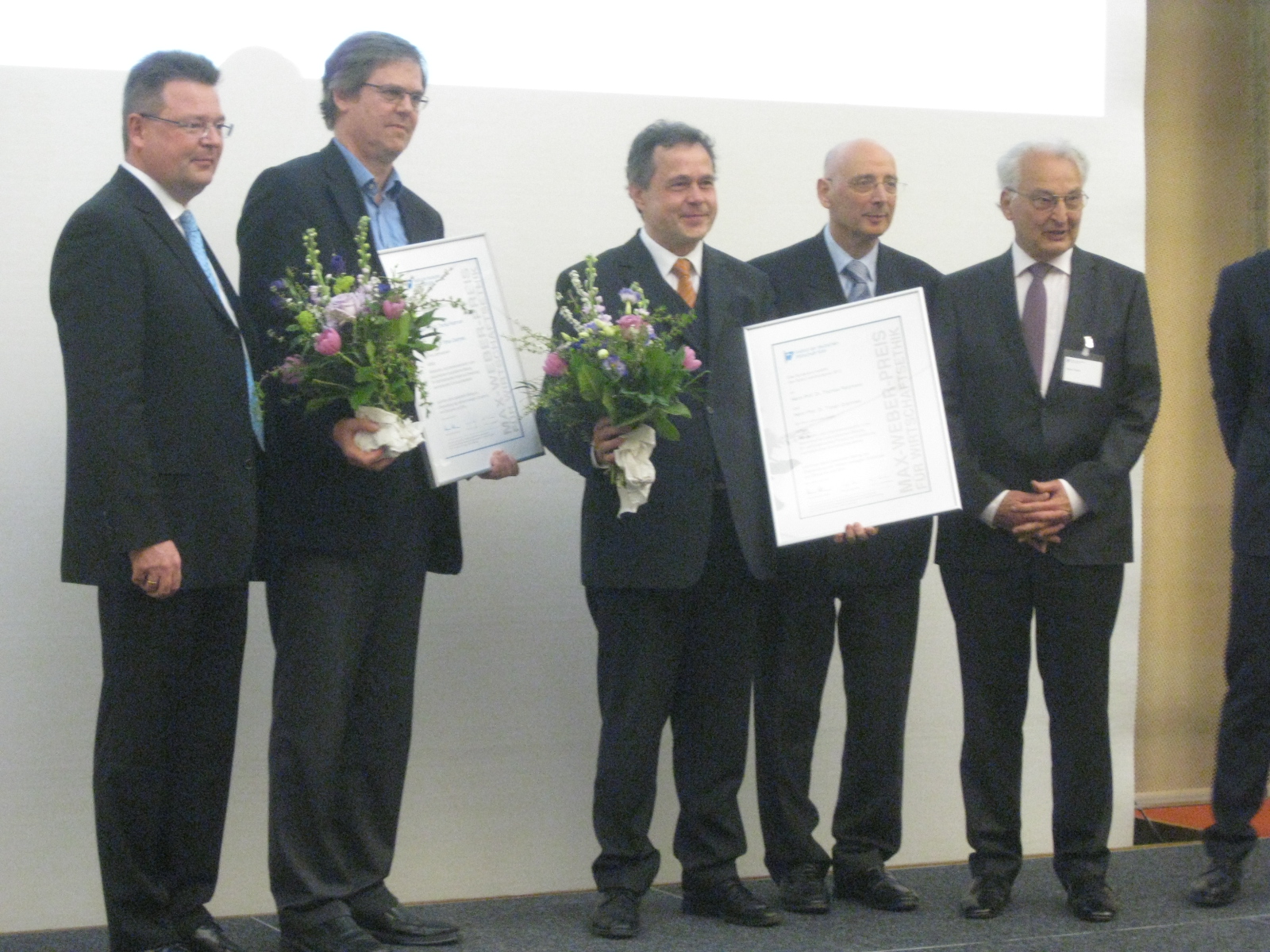
The prize winners
The ethos project, a collection of 15 exemplary teaching models on issues of business and corporate ethics, has been awarded the 2012 Max Weber Prize for Business Ethics. Awarded every two years, the prize recognises contributions to issues of business ethics, with a particular focus on the balance between economic and social responsibility in business practice.
Professors Thomas Retzmann (University of Duisburg-Essen) and Tilman Grammes (University of Hamburg) received the prestigious award for their subject-specific teaching methodology and 15 teaching modules, tried and tested in schools, which facilitate reflection on business ethics and the development of moral judgement in politics and economics lessons. The teaching modules are available free of charge to anyone interested at http://www.ethos-wirtschaft.de/.
All ethos teaching units are designed as modular teaching components, and the material has been deliberately developed to engage pupils. Each component contains a self-contained case study, accompanying worksheets and ready-to-copy slide templates. Fundamental insights can be gained from all the case studies, which can be applied to other cases and situations. All modules can be used individually, without the others.
The authors of the individual modules are subject matter experts and/or practising educationalists themselves. To ensure the widest possible dissemination of the teaching modules, they have been designed to fit seamlessly into standard curricula for economics and political education.
The following teaching modules are available at http://www.ethos-wirtschaft.de/.
- Corporate Social Responsibility: Should companies ensure environmental and social standards? Possibilities and limitations of ethical corporate engagement in a competitive environment
- Environmental and social labels: How informative and credible are they? On eliminating information asymmetries in the ethical consumption of goods
- Social and environmental standards in goods production: Where are the ethics? Public pressure on companies through anti-corporate campaigns
- Suppliers put to the CSR test – a contribution to promoting sustainable consumption? Corporate policy and behaviour under ethical scrutiny
- Patents on essential medicines – lifesavers or a death sentence for the sick? The design of the regulatory framework as a problem of business ethics
- Compliance management – a magic bullet against corruption? The corporate fight against bribery and corruption
- Cold calling – harassment through unsolicited telemarketing. Civic engagement to safeguard one’s own freedom
- Social dilemmas – When self-interest conflicts with the common good! A classroom experiment on a standard business ethics scenario
- Ethical investment – my money for sustainable development? A methodology for investors to compare ethical investments
- The market for illicit drugs – Drugs as a commodity and the state as a drug dealer? State drug policy in the light of economic principles
- Product and brand piracy – the curse of the market economy? The protection and disregard of intellectual property in the globalised economy
- Ombudsman procedures – A level playing field between businesses and customers? The out-of-court enforcement of legitimate claims as a contribution to contractual compliance
- Insurance fraud – a national pastime without side effects? Ethical standards and economic advantage in a selected dilemma
- The German Advertising Council – a success story for ethics in advertising? Possibilities and limitations of ethical self-regulation, using the advertising industry as an example
- Whistleblowing – Betrayal or responsible action? Opportunities and risks of individual ethics in the workplace