
20.02.2018
CUT-UP addresses sustainability in materials procurement
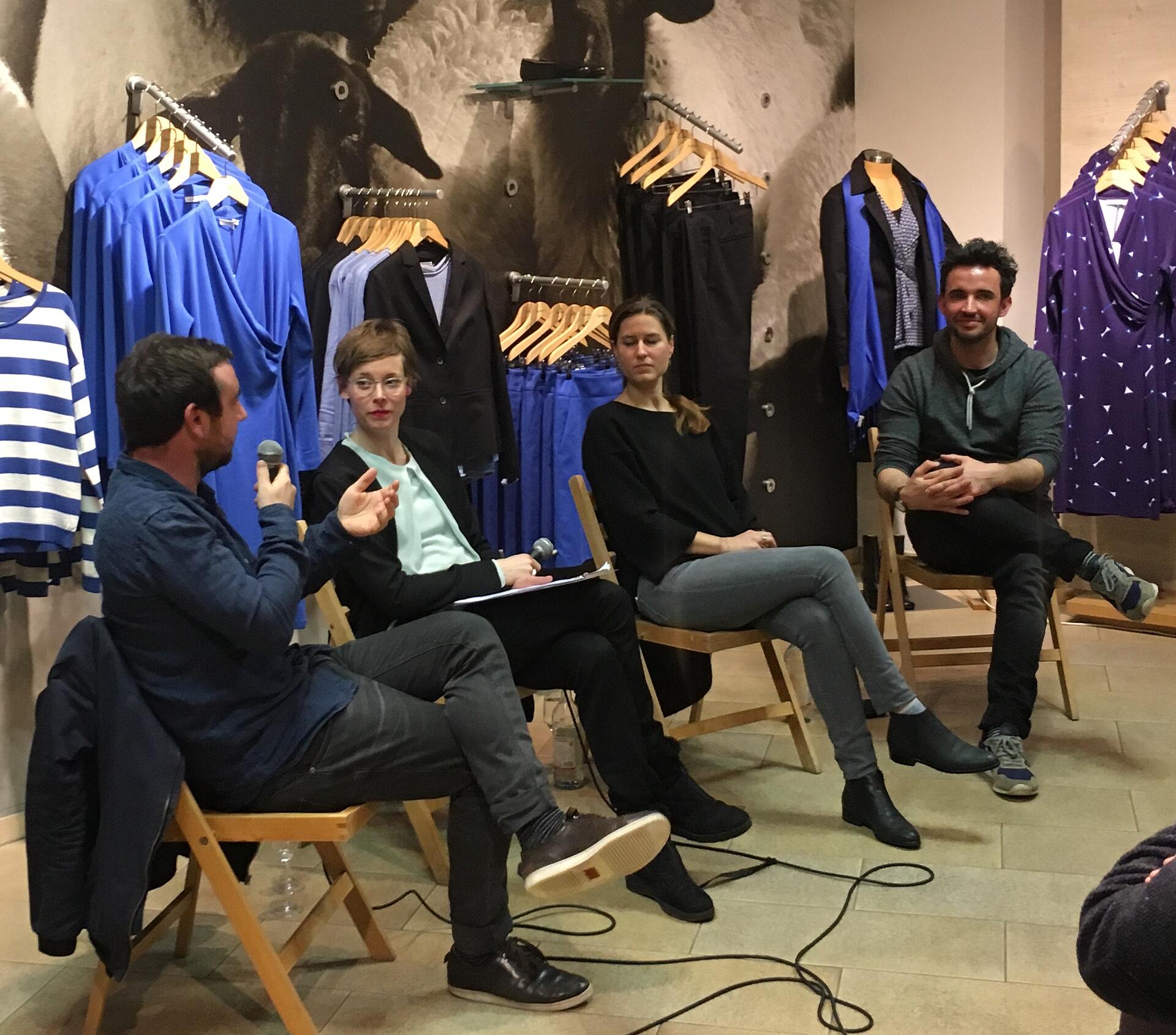
How sustainable a garment is depends not least on the materials used. At CUT-UP, presenter Irina Rohpeter discussed what companies in the textile industry should look out for when sourcing materials with host Kristin Heckmann (hessnatur), Benjamin Itter (Lebenskleidung) and Jan Thelen (Recolution).
One of the key topics of the evening was the question of the origin of raw materials. Benjamin Itter explained that the traditional cultivation of cotton – the most commonly used material in the clothing industry – makes it possible, for example, to manage without the irrigation systems used in many artificial monoculture landscapes. This benefits smallholders on the one hand, whilst also protecting the environment on the other. Whether this approach can meet the rising demand, particularly for organic cotton, remains questionable. Nevertheless, Kristin Heckmann also advocated using raw materials from traditional growing regions and carrying out subsequent processing steps locally as well. This would shorten transport routes and make use of the processing expertise of local production facilities.
For companies that require only small quantities or do not wish to define their own procurement standards, certified materials could be a good alternative, said Jan Thelen. The Global Organic Textile Standard (GOTS), for example, sets out specific environmental and social requirements for the processing of textiles made from organically produced natural fibres. However, any weaknesses in standards – for example, in the formulation of social criteria – should then be offset by other measures, according to Kristin Heckmann. Long-term, partnership-based relationships with suppliers and producers are an important component of this.
A legal framework could improve companies’ ability to make the sourcing and manufacture of products both sustainable and competitive, said Benjamin Itter. He called on policymakers to tighten regulations. Kristin Heckmann, on the other hand, advocated a voluntary commitment by companies. The Textile Alliance, founded in 2014 on the initiative of the German government, is a relevant and necessary development within the industry and could help to drive environmental and social improvements along the textile value chain.
The next event in the CUT-UP series, expected to take place in April 2018, will address issues relating to the circular economy. CUT-UP is a collaboration between Bridge&Tunnel, designxport, Frauke von Jaruntowski and the Hamburger Stiftung für Wirtschaftsethik. Over a two-year period running until the end of 2018, the discussion series will explore topics including sustainability, fair trade and supply chain transparency.