
11.10.2012
Global Economic Ethics: Convergence of Values between China and Germany
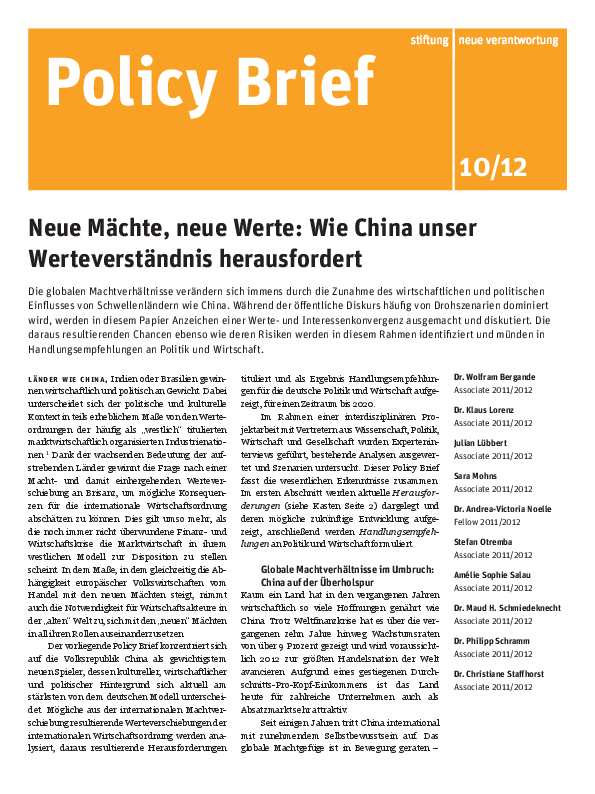
New powers, new values
The focus of the one-year project carried out by the interdisciplinary group – comprising representatives from business, NGOs, academia and politics – on the topic of ‘Global Economic Ethics – New Powers, New Values?’ was the question of possible shifts in values brought about by the growing economic and political influence of emerging powers such as China and India.
The “Global Economic Ethics” project run by the Berlin-based foundation neue verantwortung came to a close with a panel discussion on 11 October. The findings of the think tank group were presented and discussed with:
- Dr Christine Hohmann-Dennhardt (Member of the Board of Management, Daimler AG)
- Dr Hans-Joachim Preuß (Member of the Executive Board, German Society for International Cooperation (GIZ))
- Prof. Dr. habil. Josef Wieland (Konstanz Institute for Values Management)
The findings of the empirical research and expert surveys point to a scenario that anticipates a convergence of values between China and Germany in the medium term. Crucially, the existing core of shared values will remain unchanged; however, at the operational level, mutual adaptation will take place due to culturally determined differences in the interpretation and prioritisation of these values.
The realisation amongst China’s political leadership that the country’s internal stability and its own rule depend directly on economic development means that economic considerations will be the driving force behind political decisions more than ever before. As economic growth continues and the country develops into one with its own high potential for innovation, issues such as legal certainty, education and research, as well as the protection of property and freedom, will simultaneously become increasingly important. Furthermore, the rise of a middle class with a certain level of education, experience abroad and a steady income will also support the emergence of a civil society.
Even though, from a European perspective, these developments may at first glance primarily facilitate future cooperation, there can be no question of one-sided adaptation or ‘Westernisation’. Rather, issues such as the importance of community and trust, as well as the value of networks and cooperation, will pose significant challenges to German companies, as will the continuing close interdependence of business and politics.
Through concrete recommendations for action, the Policy Brief therefore highlights ways in which a balance can be struck between upholding one’s own values and principles whilst maintaining openness and a willingness to learn in day-to-day business life.