
07.05.2013
The ‘Stadt! Macht! Schule!’ project publishes a position paper
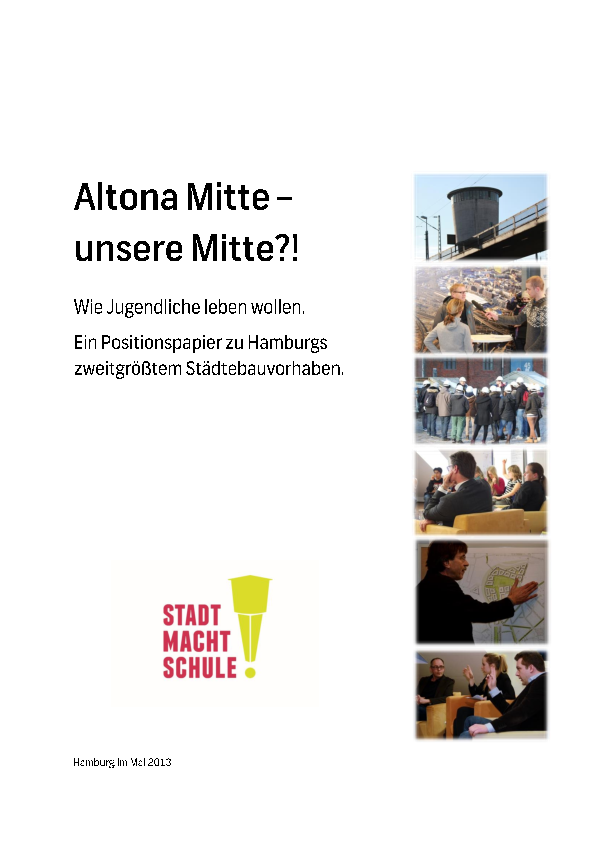
For eight months, the participants in the ‘Stadt! Macht! Schule!’ project have been carrying out research, holding discussions, interviewing numerous experts and exploring the area during site visits. The young people’s topic: What do we want ‘Mitte Altona’ to be like? The group has summarised its findings in a position paper, which is now available.
Under the title “Altona Mitte – our centre?!”, the young people from Hamburg explain, over just under nine pages, what is particularly important to them in the planning of the new neighbourhood, which will comprise 3,500 flats, a school and a park.
The project group, comprising pupils from five schools, met for the first time in autumn 2012 and began by familiarising themselves with the basics of urban development and public participation. Architect André Poitiers explained his masterplan for what is currently Hamburg’s second-largest urban development project to the young people, whilst critic Mario Bloem presented his alternative proposal. This was followed by discussions with, amongst others, politicians from the government and the opposition, representatives of the Ministry of Urban Development and the Environment, the landowners of the development site, and the journalist and activist Christoph Twickel. On an online platform developed for ‘Stadt! Macht! Schule!’, many more young people from Hamburg contributed their own proposals for ‘Mitte Altona’ and voted on them.
In their position paper, the pupils call for Altona’s ‘social mix’ to be preserved through the provision of affordable housing and propose land-use concepts that take into account both economic interests and the need for leisure and cultural facilities. The group also comments on the location and design of the neighbourhood school planned for the area.
Stadt! Macht! Schule! is a project run by the Hamburger Stiftung für Wirtschaftsethik and is funded by the Robert Bosch Stiftung. The participants will publicly present their position paper and a video documentary on 24 May at the project’s closing event.