
01.10.2019
Teaching module on the social and environmental impacts of gold mining
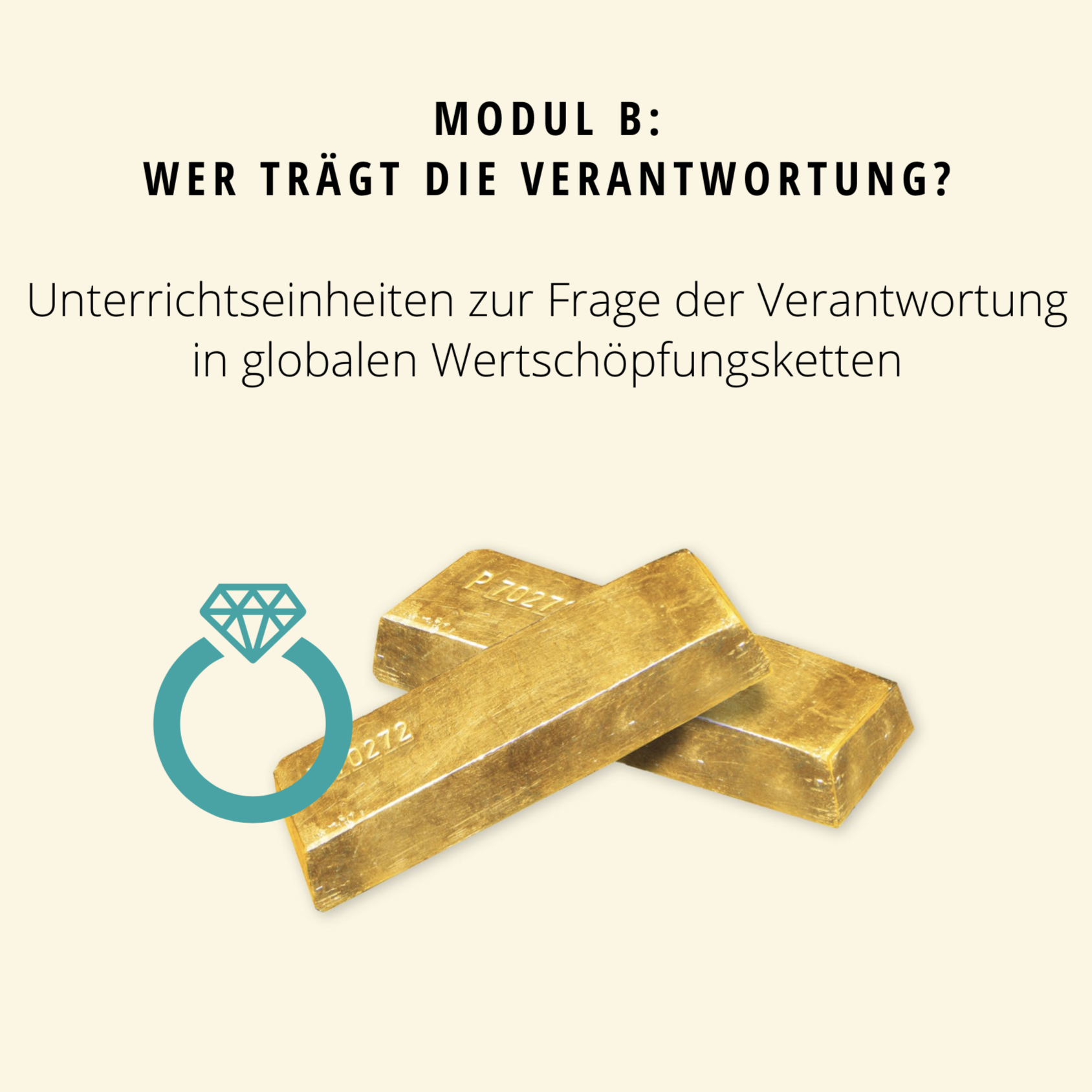
Whether as a wedding ring, a necklace or in a smartphone: these days, almost everyone carries gold around with them, even if it is only a few milligrammes. Whilst this precious metal is ubiquitous in our everyday lives here in Germany, its mining elsewhere has catastrophic consequences for people and the environment. The dark side of gold is the subject of a teaching module for vocational and general education schools, which is now available free of charge as a new publication resulting from a joint project between the Dr. Jürgen Meyer Stiftung, Cologne, and the Hamburger Stiftung für Wirtschaftsethik.
Using Peru – the world’s sixth-largest gold-producing country – as an example, the pupils discuss the question of who is responsible for the negative impacts of raw material extraction: Should the government introduce stricter laws and monitor compliance more effectively? Do mining companies need to take greater account of the interests of the indigenous population? What role do small-scale miners play in the spread of child labour and environmental destruction? And how should industrial companies and consumers in Germany and Europe respond?
In this teaching module, pupils explore the issue of responsibility from the various perspectives of the stakeholders involved in politics, business and civil society. In this way, they not only gain an understanding of key facts regarding mining, the supply chain and the use of gold, but also discuss, in a panel of experts, the areas of conflict and the intersections of interests between governments, companies and NGOs. The learning objectives of this unit focus in particular on strengthening students’ ability to engage in discourse, take action and exercise sound judgement.
The teaching material is published as the eleventh module in the ‘VIEW! – Responsibility in Business’ series, a collaborative project between the Dr Jürgen Meyer Stiftung and the Hamburger Stiftung für Wirtschaftsethik. In addition to an introductory module on moral judgement based on dilemma scenarios, units are also available on global value chains in the textile and mobile phone manufacturing sectors, as well as in cotton, palm oil, timber and soya production, and in the cocoa, fisheries and tourism sectors.
“Corporate responsibility and due diligence in global supply chains are an important subject in schools and vocational training,” said Rüdiger Winkler, Executive Director of the Dr Jürgen Meyer Stiftung. “Our project aims to help introduce young people to issues of business ethics in an unbiased and appropriate manner.” Establishing a close thematic link to the vocational fields of apprentices through sector-specific modules is a key feature of the joint project. “The high demand from schools shows that this concept is proving its worth and that our teaching materials are sparking a keen interest among learners in these rather complex issues,” said Dr Jesco Kreft, Executive Director of the Hamburger Stiftung für Wirtschaftsethik.
All modules of the teaching concept “VIEW! – Responsibility in Business”, including photocopiable worksheets, background materials, teaching guides and recommendations for implementation, are available free of charge as PDF downloads.
“VIEW! – Responsibility in Business” is a collaborative project between the Dr. Jürgen Meyer Stiftung and the Hamburger Stiftung für Wirtschaftsethik. The Dr. Jürgen Meyer Stiftung is a charitable foundation based in Cologne. In accordance with the wishes of the founder, the entrepreneur Dr Jürgen Meyer, who passed away in 2007, ‘ethics in business’ is at the heart of the foundation’s purpose. The non-profit Hamburger Stiftung für Wirtschaftsethik focuses its work on raising awareness of and discussing business and responsibility.
Downloads
-
VIEW! teaching resources on the topic of gold (PDF download)
-
Press release (PDF download)