
Didactic Principles
Didactic Principles
School subjects, just like academic disciplines and theories, are structured systematically. Their systematic structure can (and must) be learnt.
Every practical case seems – despite certain similarities – to be a unique, individual instance. To understand it fully, one must study it casuistically (casuistry = the study of individual cases). This makes practice almost impossible to grasp. No sooner have you grasped it than it has already changed.
How are the theory and practice of business ethics combined in the ethos project?
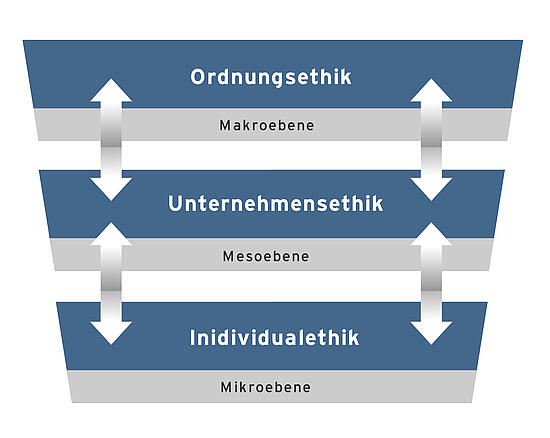
- Theory & Systematics: All ethos modules are based on a topology of ethics in the market economy (topology = the study of places). It serves as a recurring pattern for business ethics thinking and ensures the exemplary nature of the examples provided.
- Practice & Case Studies: The ethos modules address current issues, case scenarios and practical situations. They thus reflect ethical or unethical business practices at three levels: the economic system, individual companies and business citizens.
Didactic Principles
Navigation
- The ethos Project
- Didactic Principles
- Teaching units