
13.12.2018
CUT-UP addresses overconsumption in the clothing industry
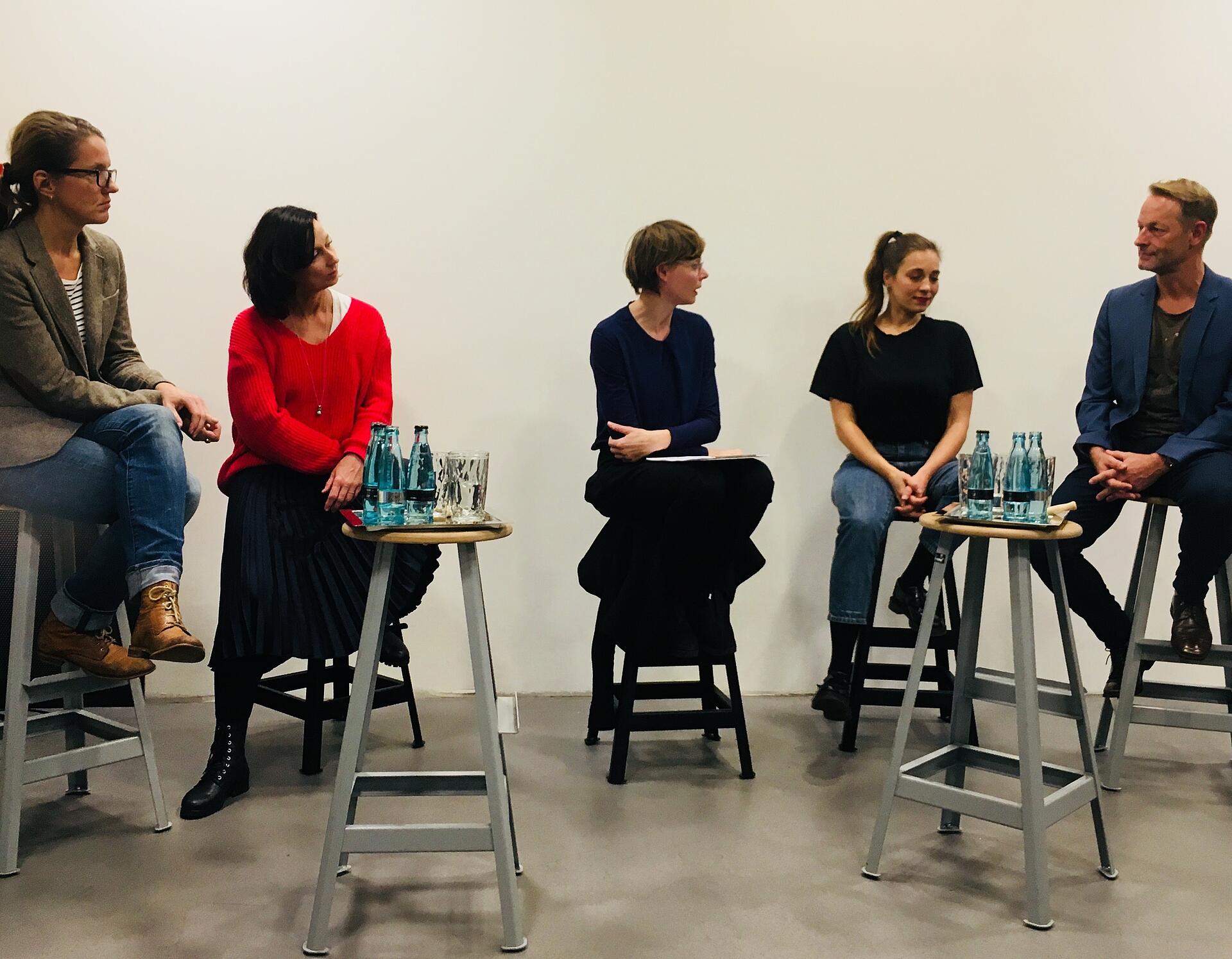
Participants in the discussion at CUT-UP (from left): Silke Wawro (TU Dortmund), Sandra Coy (Tchibo), Irina Rohpeter (moderator), Anna Schunck (journalist) and host Dr Norbert Taubken (Scholz & Friends Reputation)
Whether online or in-store, consumers have long since become accustomed to a constantly changing range of products. When manufacturers and retailers entice customers with a constant stream of new collections, ‘shopping’ often becomes a leisure activity – disconnected from actual need. The origins of this overconsumption and its consequences were the subject of the CUT-UP discussion series on 6 December 2018.
When young people have a wardrobe containing just 30 items of clothing, we’ve recently come to call this a ‘capsule wardrobe’. Yet what fashion magazines now praise as a new form of frugality was still perfectly normal just a few years ago. What has happened in the meantime? Presenter Irina Rohpeter discussed this with host Dr Norbert Taubken (Managing Director of Scholz & Friends Reputation), Silke Wawro (TU Dortmund, Institute for Art and Material Culture), Sandra Coy (press spokesperson for Corporate Responsibility at Tchibo) and Anna Schunck (journalist and co-founder of the online magazine VIERTEL VOR).
According to Anna Schunck, the industry creates desires, whilst at the same time the media’s constant incentives increase the pressure on consumers. Silke Wawro pointed out that a wide range of low-cost goods is a decisive factor, as for many people, overconsumption is only possible because of low price levels. This is particularly evident among the younger demographic. A lack of awareness, as well as the influence of the social environment – which often interprets consumption in a positive light – also play a significant role, according to Dr Norbert Taubken.
Nevertheless, Sandra Coy noted that hardly any clothing company can afford to ignore the issue of sustainability these days. Consumers, too, are increasingly interested in the social and environmental aspects of production. It is important to present the concept of sustainability in a positive light to them, whilst at the same time raising their awareness of the concept’s complexity. Sandra Coy explained that Tchibo’s strategy therefore includes reporting on projects that have not been successful.
Services such as repair schemes or hire and swap schemes, implemented by major clothing brands, are finding their niche. Whether (over)consumption can be curbed in this way, however, remains questionable. In any case, profitability is not the focus, said Sandra Coy, referring to the ‘Tchibo Share’ project, in which the company rents out children’s clothing. Nevertheless, this fledgling business venture certainly offers an opportunity to draw customers’ attention to new forms of consumption. Silke Wawro also emphasised how important it is to give alternative forms of consumption a positive connotation. This is evident, for example, in her school projects, where young people repair their favourite items of clothing and then label them with a special tag. In this way, the focus can be shifted from constantly consuming new products to appreciating the things we already have.
The panellists agreed that it is fundamentally important to establish a public discourse on the topic of sustainability and to highlight alternative consumption models. Only when there is an understanding and general acceptance of new approaches can a long-term shift in consumer behaviour begin.
CUT-UP is a collaboration between Bridge&Tunnel, designxport, Frauke von Jaruntowski and the Hamburger Stiftung für Wirtschaftsethik. Over a two-year period from 2016 to 2018, this series of discussions will explore topics ranging from sustainability and fair trade to supply chain transparency, amongst others.